
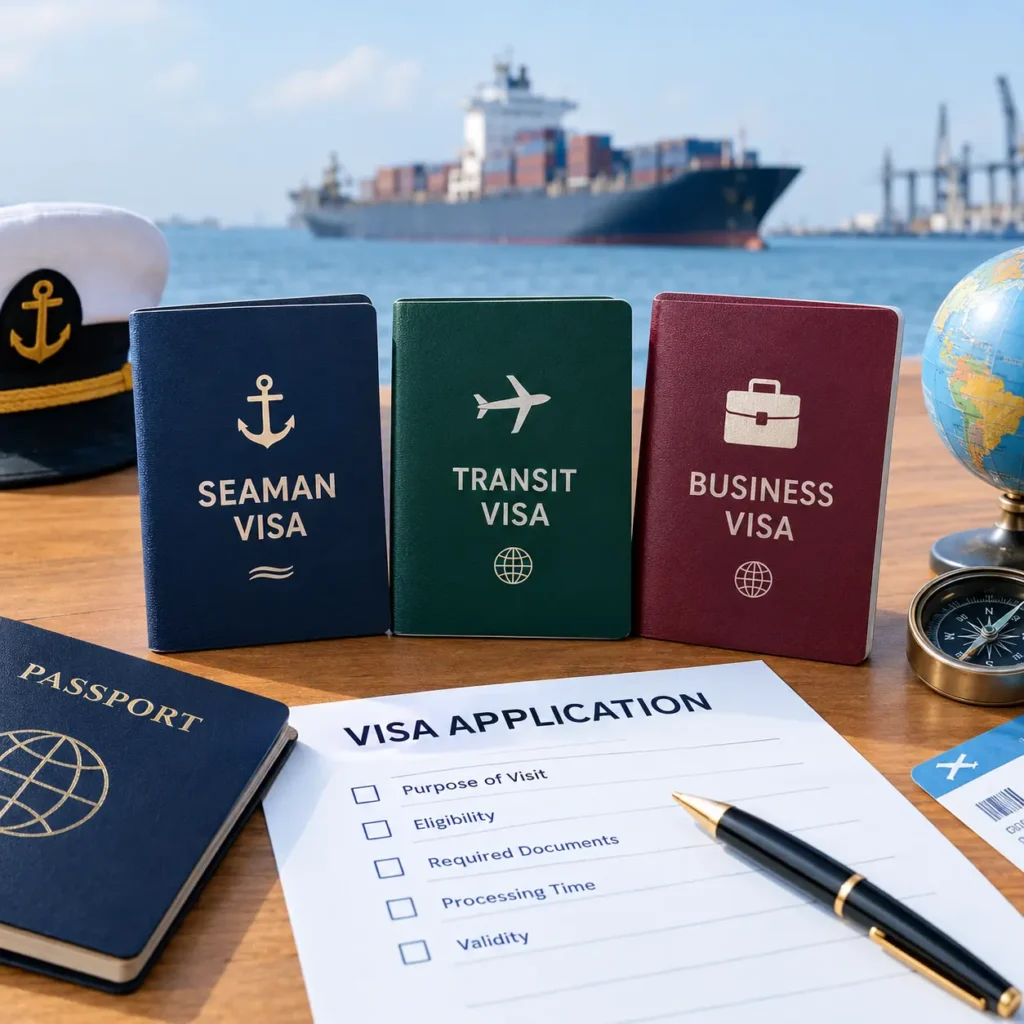
A seaman visa, transit visa and business visa serve different travel purposes. The right visa depends on why you are travelling, which country you are entering, whether you are joining or leaving a vessel, and the immigration rules that apply to your nationality.
For example, A business traveller attending a maritime meeting may need a different visa from a crew member travelling to join a ship even if both are visiting the same port.
Quick answer: A seaman or crew visa is generally associated with joining or serving aboard a vessel where that category is required. A transit visa permits qualifying passage through a country. A business visa is intended for permitted business activities. These categories are not interchangeable, and some journeys require more than one visa or a combined visa category.
Seaman Visa vs Transit Visa vs Business Visa: Key Differences
Feature | Seaman or crew visa | Transit visa | Business visa |
Main purpose | Joining or serving aboard a vessel where a crew visa is required | Passing through a country en route to another destination | Conducting permitted business activities |
Typical traveller | Eligible seafarer or crew member | Traveller passing through a country | Business visitor, company representative or eligible maritime professional |
Common reason for travel | Joining a ship, crew change or other approved crew-related travel | Connecting travel, transferring between transport or joining a vessel through a transit country | Meetings, negotiations, conferences or approved commercial discussions |
Employment permission | Depends on the specific visa and applicable rules | Does not generally authorise employment | Does not automatically authorise employment |
Possible supporting documents | Passport, crew or employment evidence, vessel details and other country-specific documents | Passport, onward itinerary and evidence of the onward journey; additional documents may apply | Passport, invitation, business purpose evidence and other documents required by the destination |
Can it replace the other categories? | Not automatically | Not automatically | Not automatically |
Important: “Seaman visa” is a broad term used differently by different countries. Some destinations use a dedicated crew visa, some issue a seafarer transit visa, and others apply different immigration arrangements.
What Is a Seaman Visa?
A seaman visa also called a seafarer visa or crew visa in some contexts, is a visa category or travel authorisation associated with eligible crew members travelling for maritime duties.
However, not every seafarer needs a dedicated seaman visa for every port call or crew change. The requirements depend on the destination’s immigration rules, the seafarer’s nationality, the vessel’s circumstances and the route taken.
When might a seaman visa be needed?
Examples include:
- A seafarer travelling internationally to join a vessel.
- A crew member entering a country under its designated crew-visa arrangements.
- A maritime worker travelling for an approved shipboard assignment where the destination requires crew-specific entry permission.
These examples are not a universal eligibility list.
Common documents for a seaman visa
Depending on the destination and application route, you may be asked for:
- A valid passport.
- A visa application form and compliant photograph.
- A seaman’s book, seafarer identity document or other relevant maritime credentials, if required.
- An employment letter, crew confirmation or contract.
- A letter from the shipowner, employer or authorised shipping agent.
- Vessel name, port and joining details.
- Flight itinerary or other travel arrangements.
- Additional supporting documents required by the embassy or immigration authority.
A seaman’s book or crew document does not automatically replace a passport or visa. Confirm which documents the destination accepts.
What Is a Transit Visa?
A transit visa allows a traveller to pass through a country under the conditions set by that country’s immigration authority.
For seafarers, this can be especially relevant when travelling by air to a port where they will join a vessel, or when changing transport en route to another destination.
The term “maritime transit visa” does not refer to one universal visa category used by every country. Some jurisdictions have specific arrangements for seafarers in transit, while others apply their ordinary transit or visitor-visa rules.
When might a seafarer need a transit visa?
- A seafarer flies through a country before joining a vessel elsewhere.
- The itinerary requires entry through immigration rather than remaining in an exempt airside transit area.
- The destination country specifically requires transit authorisation for a crew member travelling to join a ship.
- A crew member must leave one vessel and travel through a country to join another.
Whether a transit visa is required can depend on nationality, airport, terminal, layover arrangements, destination, travel documents and any applicable exemptions.
Common transit visa documents
- A valid passport.
- A completed visa application and photograph.
- Confirmed onward travel details.
- Evidence of the final destination.
- A vessel joining letter or crew confirmation, if relevant.
- A seafarer’s book or other maritime document, if required.
- Evidence of the intended transit purpose and arrangements.
Check the rules for your exact itinerary, including whether you must collect baggage, change airports or pass through immigration.
What Is a Business Visa?
A business visa permits specified business-related activities under the destination country’s rules. It may be relevant to maritime professionals who are travelling for commercial discussions rather than to perform duties as shipboard crew.
Depending on the country, permitted activities may include:
- Attending business meetings.
- Negotiating commercial agreements.
- Meeting clients, suppliers or business partners.
- Participating in conferences or trade events.
- Discussing maritime services, contracts or procurement.
A business visa does not automatically authorise paid work, local employment or shipboard duties.
When might a maritime professional need a business visa?
Consider a shipping company representative travelling to meet a port agent, negotiate a service agreement or attend a maritime conference. If the visit falls within the destination’s permitted business activities, a business visa may be appropriate where one is required.
That is different from a crew member travelling to join a vessel for work. In that situation, the correct category must be checked against the country’s crew and immigration rules.
Common business visa documents
- A valid passport.
- A completed application form and photograph.
- An invitation letter from the host company.
- A letter from the applicant’s employer.
- Evidence of the business purpose and proposed itinerary.
- Company registration or business details, where requested.
- Evidence of accommodation or funding, if required.
- Additional documents requested by the embassy or visa authority.
The invitation letter should accurately explain the purpose of the visit. It should not describe a crew assignment as a business meeting if the applicant is actually travelling to work aboard a vessel.
Seaman Visa vs Transit Visa: What Is the Difference?
The main distinction is the purpose for which the destination permits travel.
A seaman or crew visa is associated with an eligible crew member’s maritime duties or crew-related entry. A transit visa is associated with passing through a country to reach another destination.
The two purposes can overlap during a real journey. For example, a seafarer may need to travel through one country to join a vessel in another. In that situation, the transit country’s rules and the vessel country’s rules must both be checked.
Example: Travelling to join a ship
Imagine an Indian seafarer travelling from India through a third country to join a vessel at a foreign port.
Before departure, the seafarer should verify:
- Whether the transit country requires a visa for an Indian passport holder on the exact itinerary.
- Whether the seafarer must enter the transit country or can remain in an exempt international transit area.
- Which visa or authorisation is required to enter the vessel’s joining country.
- Whether a crew letter, vessel details, employment evidence or additional maritime documents are required.
- Whether the airline’s document checks match the official entry requirements.
Seaman Visa vs Business Visa: Which One Applies?
Travel situation | What to investigate |
Travelling to join a vessel as an employed crew member | The destination’s crew or seaman visa rules, plus any transit requirements |
Attending a shipping conference | The business or visitor category permitted for that event |
Meeting a port agent to discuss a commercial contract | The destination’s permitted business-visitor activities |
Travelling to inspect a vessel before an assignment | The exact purpose and whether it falls under a business, crew or other category |
Performing work or providing services while in the country | Whether a work-authorising category or special maritime arrangement is required |
When the purpose is unclear, for example, a visit that combines a business meeting with a shipboard assignment, seek confirmation from the relevant embassy or immigration authority before applying.
Business Visa vs Sea Transit Visa: Can One Replace the Other?
Usually, you should not assume that either category can replace the other.
For example, a shipping manager travelling to a commercial meeting may need a business visa if the destination requires one. A seafarer flying through a country to join a ship may instead need transit authorisation, crew-specific permission, or another category specified by the relevant authority.
The visa label alone is not enough to determine eligibility. Check the permitted activities, entry conditions, validity and stay limits attached to the visa.
Visa Requirements for Seafarers Joining a Ship
Preparing the following information will help you establish which requirements apply.
Identity and travel documents
- Valid passport.
- Seafarer’s book or identity document, if required.
- Completed application form and compliant photograph.
Proof of maritime assignment
- Employment contract, joining letter or crew confirmation.
- Vessel name and joining port.
- Shipowner, employer or shipping-agent contact details.
- Supporting maritime credentials where required.
Journey and entry details
- Flight itinerary and transit points.
- Destination country’s visa or entry requirements.
- Any onward ticket or proof of onward travel.
- Accommodation and funding evidence, if requested.
Application-specific requirements
- Invitation letter for a business visit, if applicable.
- Employer letter explaining the travel purpose.
- Appointment confirmation, fee payment or additional forms, where required.
The authority may require different documents or additional evidence.
Which Countries Require a Transit Visa for Indian Citizens?
The answer may depend on whether the traveller is:
- Remaining in the international transit area.
- Changing terminals or airports.
- Collecting baggage and checking in again.
- Entering the country during a layover.
- Travelling to join a ship under a crew-related arrangement.
- Holding another valid visa or residence permit that qualifies for an exemption.
Airside transit exemptions and entry visas are not the same thing. An exemption may also depend on the airport, airline, itinerary, destination and travel documents.
How to check transit requirements
- Identify every country where the journey stops.
- Confirm whether the itinerary requires passing through immigration.
- Check the official immigration or embassy guidance for Indian passport holders.
- Review the rules for seafarers travelling to join a vessel, where applicable.
- Confirm requirements with the airline and authorised travel or visa provider before departure.
Seaman, Transit and Business Visa Requirements in the Middle East and Europe
Visa requirements for seafarers and maritime professionals vary across the Middle East and Europe.
The Gulf region is an important destination for seafarers, offshore personnel, shipping-company representatives and maritime contractors. However, a visa that permits a business visit in one country should not automatically be assumed to permit crew-related travel in another.
Saudi Arabia: Seafarers travelling to Dammam, Jubail, Jeddah, Yanbu or other Saudi ports should establish whether their journey falls under a sea transit, business visit, work or another applicable visa category. Read our guide to the Saudi Arabia Seaman Visa and Maritime Crew Visa process.
Bahrain: Foreign visitors attending business meetings and seafarers joining or leaving vessels may follow different immigration procedures. Explore our Bahrain Business Visa guide for business-visit information.
United Arab Emirates (UAE): Requirements can vary according to the emirate, the traveler’s nationality and whether the visit involves a business meeting, vessel joining or work. Confirm the applicable entry route before booking travel.
Oman and Qatar: Seafarers travelling through these countries should check the relevant crew, transit or visitor arrangements against their exact itinerary and purpose.
Official resource: Government of Oman — Get Sailor’s Transit Visa.
For assistance with regional visa requirements, document preparation and application coordination, visit Maritime Visas.
United Kingdom: Seafarers travelling to join a vessel, changing ships or passing through the UK should check the applicable UK immigration and transit requirements.
Official resource: UK Government — Seafarers guidance.
Common Mistakes to Avoid
Assuming a seaman visa is valid everywhere. Visa categories and exemptions differ by country.
Confusing a transit visa with permission to work. Transit permission generally does not authorise employment.
Using a business visa for shipboard duties without confirmation. Business-visitor permission does not automatically cover work aboard a vessel.
Ignoring transit countries. A visa for the final destination does not automatically permit entry into or transit through another country.
Checking only the visa’s expiry date. Also check permitted entries, duration of stay, conditions and whether the visa covers the planned purpose.
Applying with an unclear travel purpose. Your application, employer letter, invitation and itinerary should accurately describe what you intend to do.
Relying on outdated requirements. Verify current rules before booking or departing, especially when a vessel joining date is fixed.
Frequently Asked Questions – FAQs
What is the difference between a seaman visa and a transit visa?
A seaman or crew visa is associated with an eligible crew member’s maritime duties or crew-related entry. A transit visa permits qualifying passage through a country. Depending on the route, a seafarer may need one, both, or a different authorisation.
Is a seaman visa the same as a sea transit visa?
Not necessarily. The terms can refer to different immigration purposes, and “sea transit visa” is not a universal category used in every country. Confirm the official visa type for the destination and itinerary.
Can I use a business visa to join a ship?
Do not assume that you can. Joining a vessel to perform crew duties may require a crew-specific visa or another category specified by the destination. Confirm the applicable rules before travelling.
Do seafarers need a transit visa to join a ship?
Sometimes. The answer depends on the transit country, nationality, route, airport arrangements, destination and any applicable exemptions. Some journeys may require a transit visa in addition to a crew visa.
What documents are required for a seaman visa?
Commonly requested documents can include a passport, application form, photograph, crew or employment confirmation, vessel details and relevant maritime documents. The exact list depends on the destination and visa category.
Is a transit visa required for Indian citizens?
It depends on the transit country and itinerary. Indian passport holders should check each transit point’s official rules, including whether they must pass through immigration, collect baggage or change airports.
What is the difference between a business visa and a work visa?
A business visa generally permits specified short-term business activities, subject to local rules. A work visa or work-authorising permit is intended for employment or other activities that require work permission. A business visa should not be assumed to authorise paid work.
How long is a business visa valid?
Validity varies by country, visa type and applicant. The visa’s validity period is not necessarily the same as the maximum permitted stay per visit. Check both the visa label and the issuing authority’s conditions.
Can a seaman visa be used as a transit visa?
Not automatically. A crew visa may not satisfy the transit requirements of another country. Check whether the itinerary requires separate transit permission or whether the destination offers a combined category.
What should I do if my vessel joining date is approaching?
Contact your employer or shipping agent immediately, verify the official visa requirements for every country on the route, and confirm processing arrangements with the relevant authority or authorised provider. Do not assume that a pending application or an existing visa guarantees boarding or entry.
Official Visa Resources
Use official sources to confirm the latest requirements before applying:
- U.S. Department of State — Crewmember Visa
- UK Government — Seafarers guidance
- Government of Oman — Sailor’s Transit Visa
For other destinations, consult the relevant country’s immigration authority or embassy.
Need Help Identifying the Right Visa?
Maritime Visas can help you explore the relevant visa requirements and application process for your destination. Prepare your nationality, current location, destination, intended travel date, vessel joining port and employment or invitation details before requesting assistance.
Visa eligibility and approval remain subject to the relevant authorities. Confirm the applicable requirements before finalising your travel plans.