
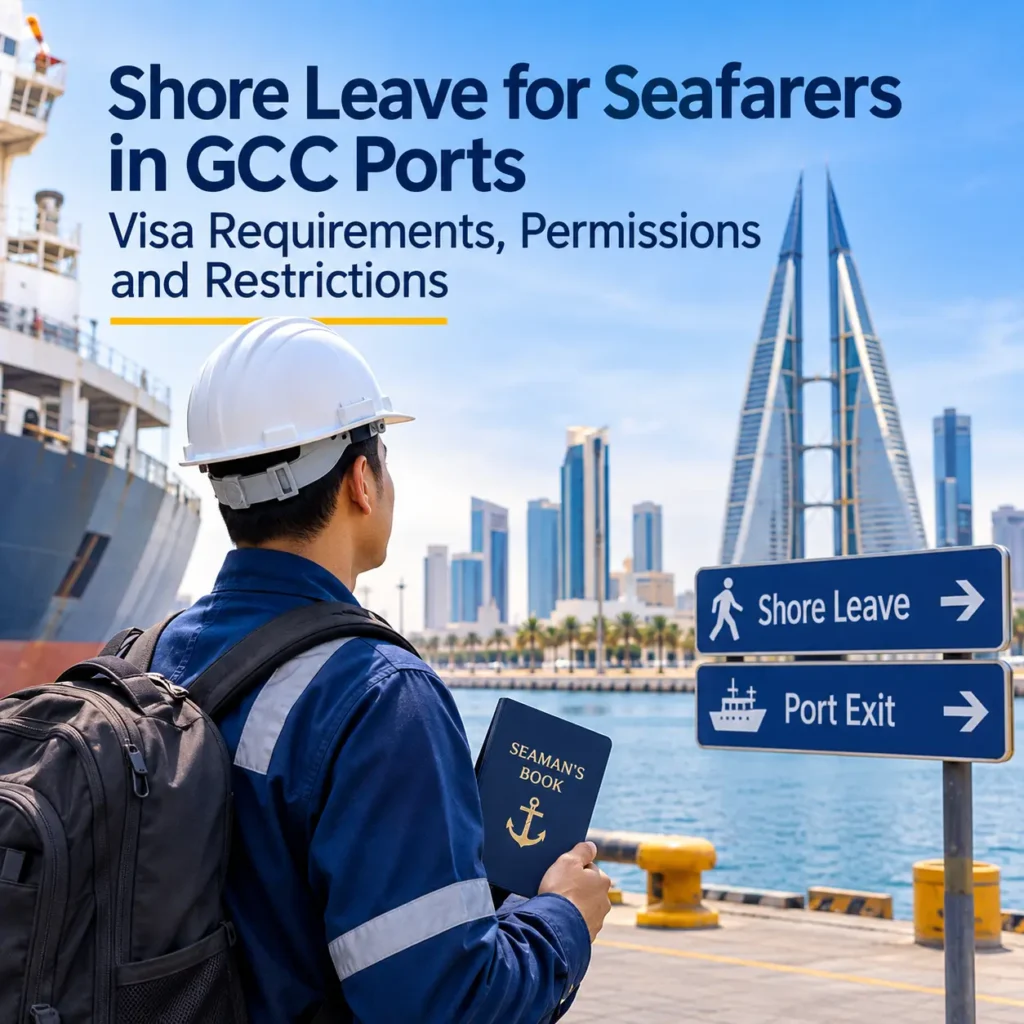
Shore leave allows seafarers to go ashore temporarily while their vessel is in port, giving crew members an opportunity to rest, access essential services and spend time on land. However, shore leave requirements in GCC ports vary by country, port authority and immigration procedures.
Seafarers visiting Bahrain, the UAE or Saudi Arabia should understand local entry rules. A Seaman’s Book supports identification but does not guarantee shore-leave permission.
Atomiq Consulting provides maritime visa and seafarer documentation support.
In This Article
- What Is Shore Leave for Seafarers?
- Do Seafarers Need a Visa for Shore Leave?
- Shore Leave vs Crew Change vs Transit: Key Differences
- Shore Leave Requirements in the UAE, Bahrain and Saudi Arabia
- Documents Required for Seafarer Shore Leave
- How Long Can Seafarers Stay Ashore?
- Can Shore Leave Be Refused or Restricted?
- 2026 Update: Shore Leave Pass Procedures in India
- Who Arranges Shore Leave Permission for Seafarers?
- Frequently Asked Questions About Seafarer Shore Leave
What Is Shore Leave for Seafarers?
Shore leave is the temporary facility for a seafarer to leave a vessel and enter the port’s land area or the surrounding country while the vessel remains in port.
Unlike crew change, shore leave does not normally involve signing off from a vessel, joining another ship or ending an employment contract. It is a temporary break during a vessel’s port stay.
Seafarers may use shore leave to:
- Rest and take a break from their duties onboard.
- Purchase personal necessities and supplies.
- Access medical, banking or communication services.
- Visit local facilities or spend time outside the port.
- Maintain personal and social connections while working at sea.
Shore leave is an important part of seafarer welfare. However, the time available may depend on the vessel’s schedule, operational requirements, port clearance and applicable immigration or security procedures.
Do Seafarers Need a Visa for Shore Leave?
A separate visa is not necessarily required for shore leave. International maritime standards provide specific facilitation measures for eligible seafarers, but the application of these standards depends on the relevant international conventions and the country’s implementation.
Two important international frameworks address shore leave:
IMO Facilitation Convention
The International Maritime Organization’s Convention on Facilitation of International Maritime Traffic (FAL Convention) establishes standards intended to simplify formalities for international shipping.
Under the shore-leave provisions in its Annex, Standard 3.45 states that crew members should not be required to hold a visa for the purpose of shore leave. Standard 3.47 also states that crew members should not be required to obtain a special permit, such as a shore-leave pass, for that purpose.
Also check IMO Resolution FAL.14(46) – Amendments to the FAL Convention (PDF)
ILO Seafarers’ Identity Documents Convention
Article 6 of the International Labour Organization’s Seafarers’ Identity Documents Convention (Revised), 2003 (No. 185), addresses shore leave and the temporary entry of eligible seafarers.
It provides for seafarers holding valid Seafarers’ Identity Documents issued under the Convention to be permitted temporary shore leave while their ship is in port, subject to the required arrival formalities and legitimate grounds for refusal, including public health, public safety, public order and national security.
The Convention also states that seafarers should not be required to hold a visa for shore leave. Where a member cannot fully implement that requirement, it must provide substantially equivalent arrangements.
Important: Local laws, port procedures, security requirements and the applicable international obligations also still matter.
Shore Leave vs Crew Change vs Transit: What Is the Difference?
Activity | Purpose | Typical immigration consideration |
Shore leave | Temporary time ashore while the vessel remains in port | Shore-leave facilitation and local port procedures |
Crew change | Joining or signing off from a vessel | Crew-change and immigration clearance |
Transit | Passing through a country or airport to reach another destination | Applicable transit-entry requirements |
Business visit | Attending meetings or professional activities | Relevant business-entry or visit visa |
Tourism | Entering a country for leisure or sightseeing | Applicable visitor or tourist visa |
For example, a seafarer going ashore for a few hours during a vessel’s port stay is in a different situation from a seafarer who signs off in Dubai and needs to travel to another country.
Shore Leave Requirements for Seafarers in GCC Ports
The GCC does not have one single shore-leave procedure that applies identically across Bahrain, the UAE and Saudi Arabia. Each country has its own immigration authorities, port systems and documentation procedures.
The following sections highlight relevant official procedures and the checks seafarers should make before going ashore.
Shore Leave Requirements in the UAE
The UAE has multiple ports and immigration authorities, so seafarers should not assume that a procedure used in one emirate applies throughout the country.
Dubai’s General Directorate of Residency and Foreigners Affairs (GDRFA) publishes a service called Issuing Sailors a Permit to Disembark.
According to the published service information, the permit:
- Allows sailors to enter the city for up to 24 hours.
- Is valid for use within seven days before entry.
- Requires an application by the relevant ship’s captain or shipping agent/representative, depending on the type of marine vessel.
- Requires a marine craft entry permit and a current personal photograph.
- Has a published fee of AED 100 plus 5% VAT.
The published service also describes an application process through the GDRFA website or at its port office.
This is a specific Dubai procedure and should not be treated as a universal rule for all UAE ports. Seafarers and shipping agents should confirm the applicable arrangements with the relevant port and immigration authority before disembarkation.
Shore Leave Requirements in Bahrain
Seafarers calling at Bahrain should confirm the applicable shore-leave and disembarkation arrangements with their vessel’s shipping agent and the relevant port and immigration authorities.
The documents and information that may be relevant to the clearance process include:
- Passport or accepted seafarer identity documentation.
- Seafarer’s position and details on the vessel’s crew list.
- Vessel arrival and port-clearance information.
- Any port-specific permission or disembarkation arrangements.
- The expected duration and purpose of the shore visit.
Do not assume that an ordinary Bahrain tourist or business visa is automatically required for temporary shore leave. Equally, do not assume that a Seaman’s Book alone provides permission to enter Bahrain.
For current requirements, the shipping agent should confirm the procedure before the crew member leaves the vessel.
Shore Leave Requirements in Saudi Arabia
The Transport General Authority’s Seamans Exit Permit service enables a shipping agent to request a permit for a seafarer to leave the port temporarily or permanently.
The published service process requires the shipping agent to:
- Access the relevant port-management licensing and permits service.
- Select the Seamen Exit Permit option.
- Enter the required information.
- Submit the application.
This is an important distinction for seafarers calling at Saudi ports: the applicable procedure should be confirmed with the shipping agent and relevant port authorities rather than assuming that ordinary visitor-visa rules apply.
The exit-permit service is also not the same as a Saudi tourist, business or crew-change visa.
Documents Required for Seafarer Shore Leave
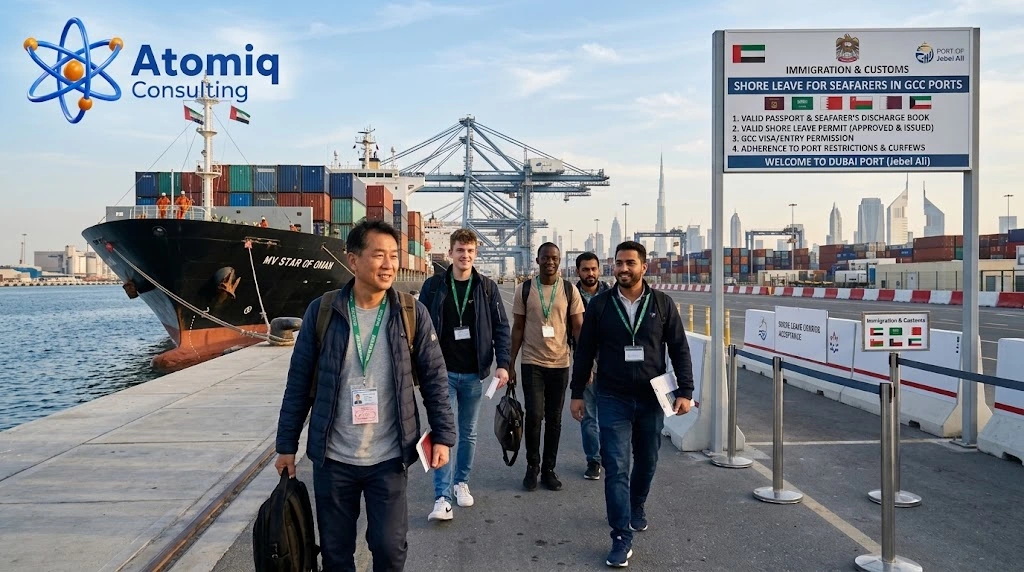
Document or information | Why it may be required |
Passport | Establishes identity and nationality |
Seafarer’s Identity Document (SID) | Provides recognised seafarer identification where applicable |
Seaman’s Book or Continuous Discharge Certificate (CDC) | Records seafarer details and service history; may support identification |
Crew list | Confirms that the individual is listed as a member of the vessel’s crew |
Vessel details | Helps authorities identify the ship and its port call |
Shore-leave or disembarkation permit | Required where the applicable local procedure calls for one |
Photograph or application details | May be required for a specific permit application |
Not every port requires every item in this table. A Seaman’s Book or CDC should not be treated as a substitute for a passport, visa or other entry permission where those are required.
Seafarers should also check whether original documents must be carried, presented to immigration or handled by the vessel’s agent under the relevant procedure.
For information about seafarer documentation and available flag-state options, visit Seaman Books
How Long Can Seafarers Stay Ashore?
There is no single worldwide shore-leave duration that applies to every vessel and port.
The time available may depend on:
- The vessel’s expected departure time.
- The crew member’s onboard duties and watch schedule.
- Port and immigration permission.
- The type and validity of any disembarkation permit.
- Local security and operational restrictions.
For example, Dubai’s published sailors’ disembarkation service specifies a stay of up to 24 hours under that particular permit. This should not be interpreted as the standard shore-leave duration across the UAE or other GCC countries.
Seafarers should always confirm their permitted return time with the vessel’s master or agent. Missing the vessel’s departure or failing to comply with the conditions of a permit can create serious operational and immigration problems.
Can Shore Leave Be Refused or Restricted?
Yes. Shore leave may be delayed, restricted or refused depending on the circumstances and applicable local rules.
Possible reasons include:
- Incomplete vessel-arrival or immigration formalities.
- Port security or restricted-access requirements.
- Public health or safety concerns.
- National security or public-order considerations.
- Missing or invalid identification documents.
- Operational requirements or an imminent vessel departure.
- A specific restriction imposed by the relevant authority.
The ILO Seafarers’ Identity Documents Convention recognises that temporary shore leave may be refused on legitimate grounds such as public health, public safety, public order or national security.
A seafarer should not assume that permission granted during one port call will automatically apply to another port or a later visit.
2026 Update: Shore Leave Pass Procedures in India
On 15 July 2026, India’s Directorate General of Maritime Administration published Circular No. 38 of 2026, titled Revised Immigration Provision Relating to Shore Leave Pass (SLP) and Crew Change (Sign-on/Sign-off) of Seafarers.
The circular concerns revised immigration provisions for shore-leave passes and crew changes in India. Seafarers and shipping agents dealing with Indian port calls should consult the circular itself for the applicable procedures rather than relying on older instructions.
This is a useful reminder that shore-leave and crew-change procedures can change over time and should be checked against current official notices.
Who Arranges Shore Leave Permission for Seafarers?
In many situations, the vessel’s master, shipping agent or authorised representative coordinates the relevant formalities. The agent may communicate with immigration, port management and other authorities and submit the required crew or vessel information.
Before going ashore, a seafarer should:
- Ask the master or designated officer whether shore leave is permitted.
- Confirm the applicable procedure with the vessel’s shipping agent.
- Check whether a specific permit or document is required.
- Confirm the permitted time ashore and the vessel’s expected departure.
- Follow the port’s security instructions and return onboard on time.
Seafarers should avoid making independent travel arrangements until the relevant permission and return arrangements are clear.
Frequently Asked Questions – FAQs
What is shore leave in shipping?
Shore leave is the temporary opportunity for a seafarer to leave their vessel and go ashore while the ship is in port. It allows crew members to rest, access essential services and spend time on land before returning onboard.
Do seafarers need a visa for shore leave?
Not necessarily. International maritime conventions provide for visa-free shore leave for eligible seafarers under the applicable conditions. However, the actual procedure depends on the country’s implementation, the seafarer’s documents and local port and immigration requirements.
Can seafarers go ashore in GCC ports?
Seafarers may be permitted to go ashore in GCC ports, subject to the relevant country’s immigration procedures, port clearance, security requirements and any applicable restrictions. The procedure should be confirmed with the vessel’s shipping agent.
Is a Seaman’s Book enough for shore leave?
Not in every case. A Seaman’s Book or CDC can support a seafarer’s professional identification, but it does not automatically replace a passport, Seafarer’s Identity Document or a specific permit where one is required.
How long can a seafarer stay ashore?
The permitted period depends on the port and the applicable permission. Some procedures specify a particular time limit. Seafarers should confirm their return deadline with the vessel’s master or shipping agent.
Can shore leave be denied?
Yes. Shore leave may be restricted or refused for legitimate reasons, including public health, safety, security, public-order concerns or incomplete arrival formalities.
Is shore leave the same as a crew-change visa?
No. Shore leave is a temporary visit ashore while the vessel remains in port. Crew change involves joining or signing off from a vessel and may require separate immigration and travel arrangements.
Who applies for a shore-leave permit?
Where a local procedure requires a permit, the vessel’s master, shipping agent or authorised representative may be responsible for submitting the application. The exact process depends on the port and country.
Need Help With Seafarer Visa or Documentation Requirements?
Shore leave, crew change, transit and vessel-joining travel can involve different documentation and immigration procedures.
Atomiq provides maritime visa and documentation support for seafarers and maritime professionals travelling across the GCC and other international destinations.
If you need assistance understanding the documentation for a seafarer visa, crew change or maritime-related journey, explore Maritime Visas.
Important notice: Shore-leave permissions, immigration procedures, visa requirements and port-specific documentation can change. The information in this article is intended as general guidance and should not be treated as confirmation of entry permission.