
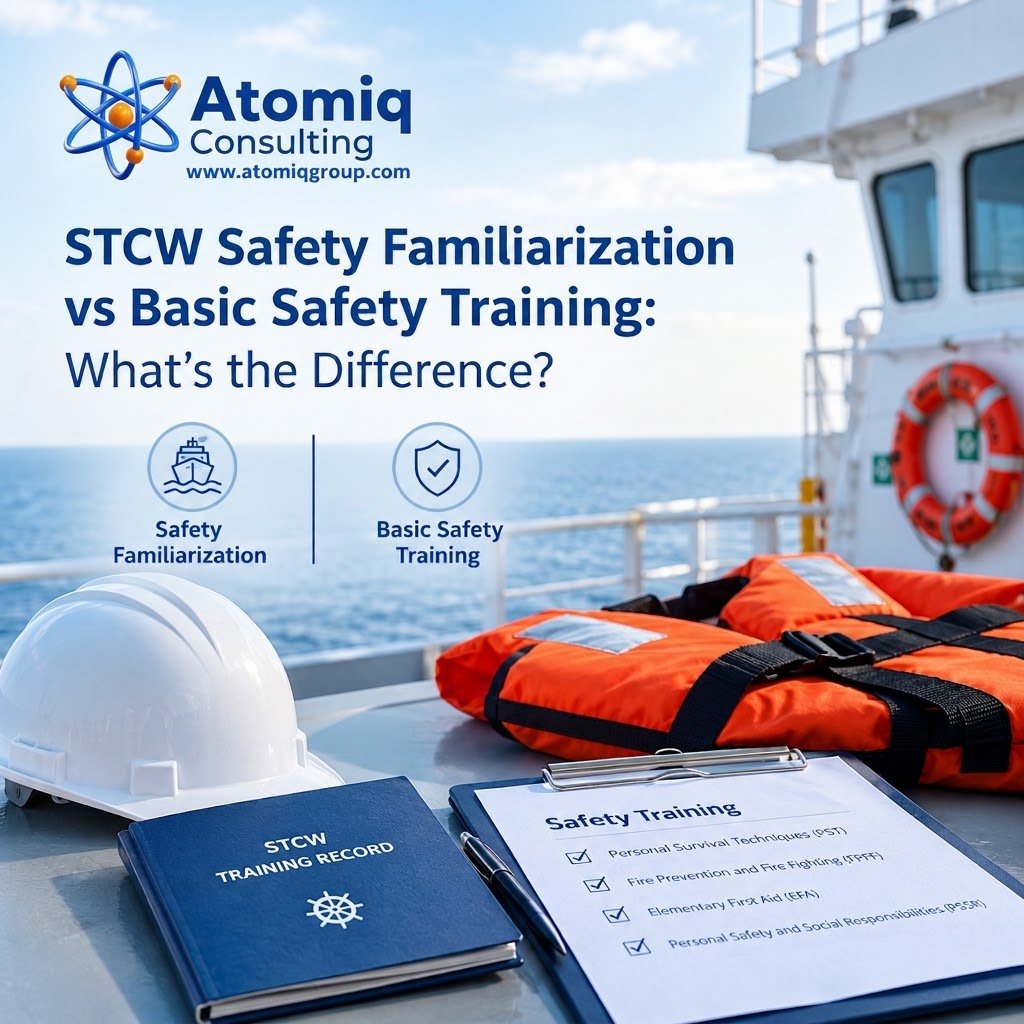
Before joining a vessel, seafarers must understand the safety procedures they will follow on board and have the training required for their assigned duties. Two terms that often cause confusion are STCW safety familiarization and STCW Basic Safety Training (BST).
Although both relate to emergency preparedness and safety at sea, they serve different purposes. Safety familiarization introduces crew members to the specific safety arrangements of the vessel they are joining. Basic Safety Training develops the essential safety competencies covered under STCW Regulation VI/1.
Understanding the difference helps seafarers prepare the correct training records and avoid confusion during pre-joining documentation checks.
Explore STCW Training Courses at Atomiq College
Looking for STCW training courses and learning options? Visit Atomiq College, Atomiq’s online platform for exploring STCW training programmes, course information and maritime learning resources.
What Is STCW Safety Familiarization?
STCW safety familiarization is an introduction to the safety arrangements, emergency procedures and equipment on a particular vessel.
Before being assigned shipboard duties, personnel must receive appropriate familiarization and instructions so they understand how to respond to basic safety situations on board.
This training is vessel-specific. The crew member needs to become familiar with the actual ship they are joining, rather than relying only on general maritime safety knowledge.
Depending on the vessel and the person’s duties, familiarization may cover:
- Emergency alarms: Understanding the vessel’s alarm signals and what actions to take when they sound.
- Muster stations: Knowing where to assemble during an emergency.
- Escape routes: Identifying emergency exits and routes to safety.
- Life-saving equipment: Locating lifejackets and understanding how to put them on.
- Fire response: Knowing how to raise the alarm and respond when fire or smoke is detected.
- Man-overboard procedures: Understanding the immediate actions required when someone falls overboard.
- Emergency communication: Knowing how to communicate basic safety information to other crew members.
- Ship-specific arrangements: Understanding relevant doors, equipment and procedures on the vessel.
The purpose is to make sure personnel understand the safety arrangements of the ship before they begin their assigned duties.
What Is STCW Basic Safety Training?
STCW Basic Safety Training is a set of foundational safety competencies established under Regulation VI/1 and Section A-VI/1 of the STCW Code.
It covers four core training components designed to prepare seafarers to respond to emergencies, prevent accidents and contribute to safety on board.
The four components are:
- Personal Survival Techniques (PST)
- Fire Prevention and Fire Fighting (FPFF)
- Elementary First Aid (EFA)
- Personal Safety and Social Responsibilities (PSSR)
These are structured training components with defined competence standards. Seafarers must complete the applicable approved training and meet the required standards under the relevant administration’s rules.
The Four STCW Basic Safety Training Courses
- Personal Survival Techniques (PST)
Personal Survival Techniques prepares seafarers to respond to emergencies that require abandoning ship and surviving at sea.
Training generally covers:
- Survival principles and emergency procedures.
- Use of lifejackets and other personal survival equipment.
- Entering the water safely.
- Boarding and using survival craft.
- Survival techniques while awaiting rescue.
- Fire Prevention and Fire Fighting (FPFF)
This course develops the knowledge and practical skills needed to prevent fires and respond to fire emergencies on board.
It generally covers:
- Common causes of shipboard fires.
- Fire prevention and safe working practices.
- Fire detection and alarm procedures.
- Types of fire extinguishers and firefighting equipment.
- Basic firefighting techniques.
- Emergency response and evacuation procedures.
- Elementary First Aid (EFA)
Elementary First Aid introduces the basic medical response skills required when someone becomes injured or unwell on board.
Topics generally include:
- Initial assessment of an injured person.
- Basic first-aid procedures.
- Control of bleeding.
- Management of shock.
- Basic resuscitation techniques.
- Seeking medical assistance and responding to emergencies.
- Personal Safety and Social Responsibilities (PSSR)
PSSR focuses on safe working practices, personal responsibilities and effective cooperation among crew members.
It generally covers:
- Safe working practices on board.
- Communication and teamwork.
- Pollution prevention.
- Understanding shipboard responsibilities.
- Contributing to a safe working environment.
- Preventing and responding to violence and harassment.
Important 2026 update: The STCW Code’s revised Table A-VI/1-4 entered into force on 1 January 2026. The updated competence requirements address the prevention of and response to violence and harassment, including sexual harassment, bullying and sexual assault. Seafarers and training providers should check that applicable PSSR training reflects the updated requirements.
Safety Familiarization vs Basic Safety Training: Key Differences
The main difference is that safety familiarization is specific to the vessel, while Basic Safety Training covers broader safety competencies.
Comparison | Safety Familiarization | Basic Safety Training |
Main purpose | Introduces personnel to the vessel’s safety arrangements | Develops foundational maritime safety competencies |
Scope | Specific to the ship | Based on STCW training standards |
Main focus | Alarms, muster stations, escape routes and onboard equipment | Survival, firefighting, first aid, personal safety and responsibilities |
Where it takes place | On board the vessel | Through applicable approved training or instruction |
Timing | Before assigned shipboard duties | Before assigned duties where required under applicable STCW requirements |
Evidence | Usually an onboard record or other evidence required by the administration | Relevant training certificates or approved documentary evidence |
Neither replaces the other. Completing a shore-based Basic Safety Training course does not automatically mean a crew member has been familiarized with the emergency arrangements of the vessel they are joining.
Likewise, receiving an onboard safety briefing does not automatically prove that the person has completed the required Basic Safety Training.
Who Needs Safety Familiarization and Basic Safety Training?
Under the STCW framework, safety familiarization applies to persons employed or engaged on a seagoing ship, other than passengers, before they are assigned shipboard duties.
Basic Safety Training requirements must be understood in the context of the person’s role, assigned safety or pollution-prevention duties, and the implementation of STCW by the relevant flag administration.
In practice, seafarers joining commercial vessels should check the applicable requirements for their position and vessel.
This may include:
- Deck ratings and engine-room ratings.
- Officers and other members of the ship’s complement.
- Catering and hotel personnel.
- Other crew members working on board.
- Personnel assigned specific safety or pollution-prevention responsibilities.
The required training and certificates may differ depending on the role, vessel type, flag-state rules and employer requirements.
Do You Need Both Before Joining a Vessel?
In many cases, yes, but they serve different purposes and are completed in different ways.
A seafarer may complete approved Basic Safety Training before joining a vessel. However, the crew member must still receive the appropriate vessel-specific safety familiarization before being assigned shipboard duties.
For example, a seafarer who has completed PST, FPFF, EFA and PSSR may already understand general emergency procedures. However, they still need to know where the muster station is on their new vessel, which escape route to use and where the life-saving equipment is located.
A practical pre-joining check should therefore consider:
- Whether the seafarer’s required Basic Safety Training is complete.
- Whether the training evidence meets the relevant flag administration’s requirements.
- Whether any additional or refresher training is required for the assigned position.
- Whether vessel-specific safety familiarization will be completed before duties begin.
- Whether the employer or crewing manager has any additional documentation requirements.
Do not assume that holding one certificate automatically satisfies every safety requirement for joining a vessel.
What Documents Should Seafarers Check?
Before joining a vessel, seafarers should review their training documents and confirm that the details match the requirements provided by the employer or vessel operator.
Depending on the role and applicable administration, the document set may include:
- Basic Safety Training certificates or approved evidence for the required components.
- Other role-specific STCW certificates.
- Valid medical fitness documentation.
- Seafarer’s identity document or Seaman’s Book, where required.
- Any additional certificates requested by the employer or flag administration.
The vessel’s safety familiarization record is generally handled through the shipboard process. It should not be confused with a shore-based Basic Safety Training certificate.
For more guidance, see our STCW Certification guide and Seaman Book Eligibility Check.
Frequently Asked Questions
Is STCW safety familiarization the same as Basic Safety Training?
No. Safety familiarization introduces personnel to the safety arrangements and emergency procedures of a specific vessel. Basic Safety Training covers four defined competencies: personal survival techniques, fire prevention and firefighting, elementary first aid, and personal safety and social responsibilities.
Is safety familiarization required before joining a ship?
Under the STCW framework, appropriate safety familiarization must be provided before a person is assigned shipboard duties. The familiarization should cover the safety arrangements relevant to the vessel and the person’s duties.
What are the four Basic Safety Training courses under STCW?
The four components are Personal Survival Techniques (PST), Fire Prevention and Fire Fighting (FPFF), Elementary First Aid (EFA), and Personal Safety and Social Responsibilities (PSSR).
Does Basic Safety Training include safety familiarization?
Not automatically. Basic Safety Training provides general safety competencies, while safety familiarization introduces the crew member to the particular vessel’s arrangements, equipment and emergency procedures.
Can I join a ship with Basic Safety Training but no safety familiarization?
Holding Basic Safety Training does not remove the requirement for appropriate vessel-specific familiarization. The familiarization must be completed before the person is assigned shipboard duties.
Is PSSR part of Basic Safety Training?
Yes. Personal Safety and Social Responsibilities is one of the four components of STCW Basic Safety Training under Table A-VI/1-4.
Is Security Awareness part of the four Basic Safety Training courses?
Security Awareness is addressed separately under STCW Regulation VI/6. Some administrations or training programmes combine it with other safety training and issue a broader certificate, but it is not one of the four core components listed under Basic Safety Training in VI/1.
Do all four Basic Safety Training certificates need refreshing every five years?
Not necessarily. The five-year refresher requirements apply to specific competencies, including Personal Survival Techniques and Fire Prevention and Fire Fighting, under the relevant STCW provisions. They should not be automatically applied to all four components. Always check the requirements of the issuing administration and the flag state concerned.
Does every seafarer need Basic Safety Training?
The applicable requirements depend on the STCW provisions, the person’s duties and the relevant administration’s implementation. Employers and flag administrations may also set additional requirements. Seafarers should confirm the exact training needed for their assigned position before joining.
Where can I check my STCW certificate requirements?
Start with the maritime administration responsible for your certificate or the vessel’s flag state. You should also confirm the requirements with your employer or crewing manager, particularly if you are joining an international vessel.
Final Thoughts
STCW safety familiarization and Basic Safety Training are both important parts of shipboard safety, but they are not the same requirement.
Basic Safety Training develops the core competencies needed to respond to emergencies and work safely at sea. Safety familiarization ensures that crew members understand how those safety arrangements apply to the particular vessel they are joining.
Before departure, check your training certificates, confirm any role-specific requirements and make sure the vessel-specific familiarization process is arranged.
Need help checking your maritime training documents? Contact Us to discuss your Seaman Book and STCW documentation requirements.