
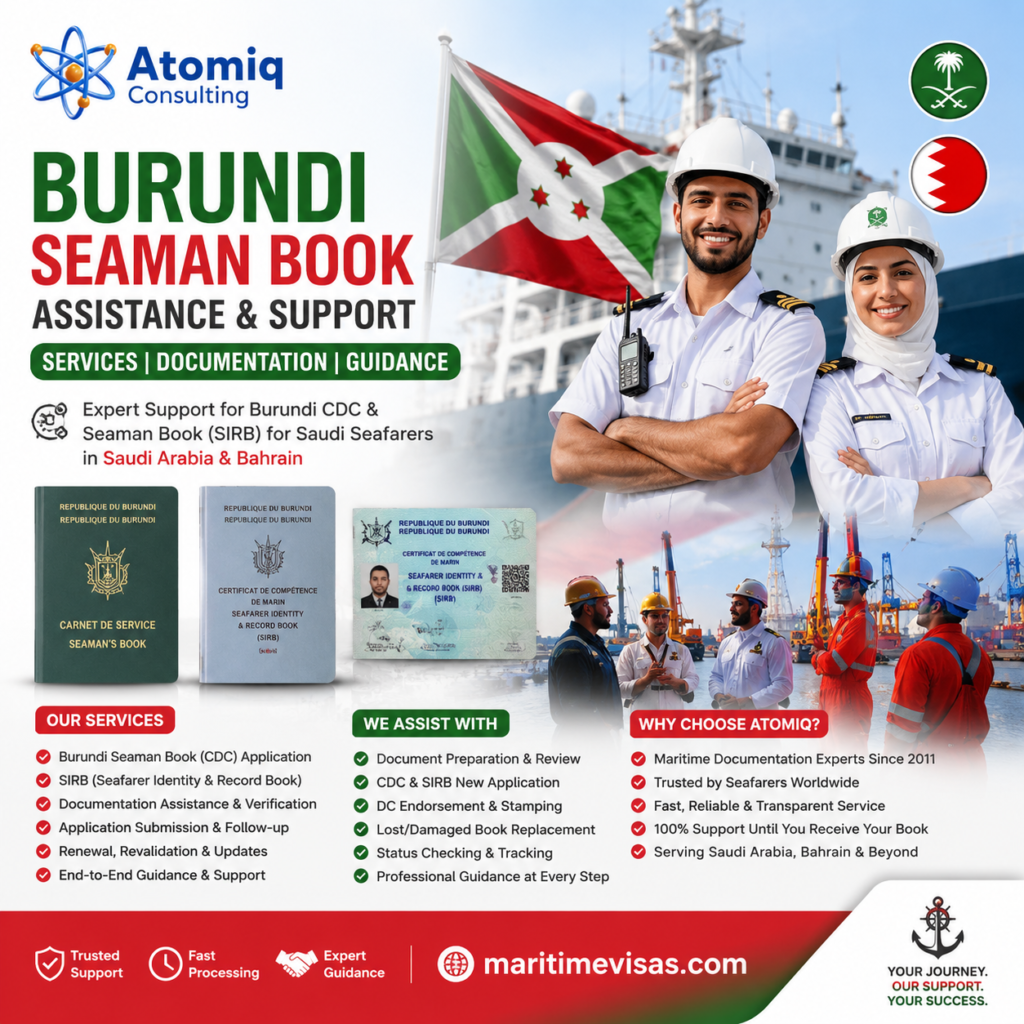
Burundi Seaman Book: What It Is, Who Recognises It, and What to Verify Before You Apply
A Burundi seaman book is a seafarer identity and record document issued by a private entity trading as Burundi International Ship Registry. Verify its standing before paying: as of 3 September 2026, Burundi does not appear on the IMO Member States list, has not ratified the ILO seafarer identity conventions, and is not on the IMO’s STCW confirmed-compliance list.
Can Atomiq Consulting help me prepare and submit my seafarer documents?
Yes. Atomiq helps qualified seafarers prepare their documents, verify that they meet requirements, and submit them correctly. If you’re unsure where to start, the next step is a free eligibility assessment to determine whether Atomiq can help with your application.

We are asked about this document most weeks, usually by a seafarer who has been quoted a low price and a short timeline, and sometimes by a manning agent whose principal has instructed them to use it. This page sets out what we were able to verify and what we could not, so you can make the decision with the same information we have. Requirements, fees and recognition practice change without notice, and are confirmed at the time of each application.
What is a Burundi seaman book?
A Burundi seaman book is a seafarer’s identity and service record document, also marketed as a Burundi CDC or Burundi SIRB, offered by an entity trading as Burundi International Ship Registry. It is presented as the equivalent of a flag-state Continuous Discharge Certificate.
A seaman book, in its ordinary international sense, does two things. It establishes who you are as a seafarer, and it records your sea service — which vessel, which rank, which dates. Immigration officers, port state control inspectors, manning agents and shipowners all read it as evidence of maritime standing rather than tourism.
The document’s value therefore comes entirely from the standing of the authority behind it. A seaman book is not useful because it exists; it is useful because the party you present it to accepts it. That is the whole question with Burundi, and it is the question no other page on this topic answers.
Two distinct instruments get conflated in this market, and the distinction matters:
- A Seafarers’ Identity Document (SID) is a convention instrument. Its form and issuance are governed by the ILO Seafarers’ Identity Documents Convention (Revised), 2003 (No. 185), or its 1958 predecessor (No. 108).
- A seaman’s book, CDC or SIRB is a flag-state or national document recording identity and sea service. Its recognition rests on the issuing state’s maritime standing, not on a convention.
Marketing that presents a “Burundi Seafarer’s Identification Document” as a SID is describing something that Burundi has no treaty basis to issue. See the next two sections.
If you are moving crew into the Kingdom, the visa work is the part we do every week — see KSA crew and maritime visa services.
What does a Burundi seaman book cost?
The registry does not publish a fee. Its online registration page states that “the fees to be provided upon request by the applicant” (burundiregistry.com, retrieved 3 September 2026). Any price you are quoted for a Burundi seaman book is therefore an intermediary’s price, not a published registry tariff, and we would not treat a low quotation as evidence of anything except a low quotation.
This is the point at which most seafarers make the decision, so it is worth being direct about the economics. Unrecognised documents are cheap because the issuing party carries no obligation and does no verification. Recognised documents cost more because a flag administration checks your certificates, your sea service and your medical fitness, and then puts its name behind the result.
The cost that matters is not the application fee. It is the cost of a document that fails at the wrong moment: a missed crew change, a flight rebooked, a mobilisation window lost, or a contractor rejecting a worker on arrival. On an offshore rotation those costs run to multiples of any registry fee.
We publish our own service fees on quotation against a defined scope, because the scope genuinely varies by nationality, rank and destination. We will tell you the fee before you commit and we will tell you if we think the case is not worth running.
What are the requirements to apply for a Burundi seaman book?
The registry’s published requirements are an application form, a copy of an existing seaman’s book or passport, a Certificate of Competency issued by a White List country, a medical fitness certificate issued within the previous 12 months, and four passport photographs. Note that the registry accepts a personal identity document where the applicant has no seaman’s book.
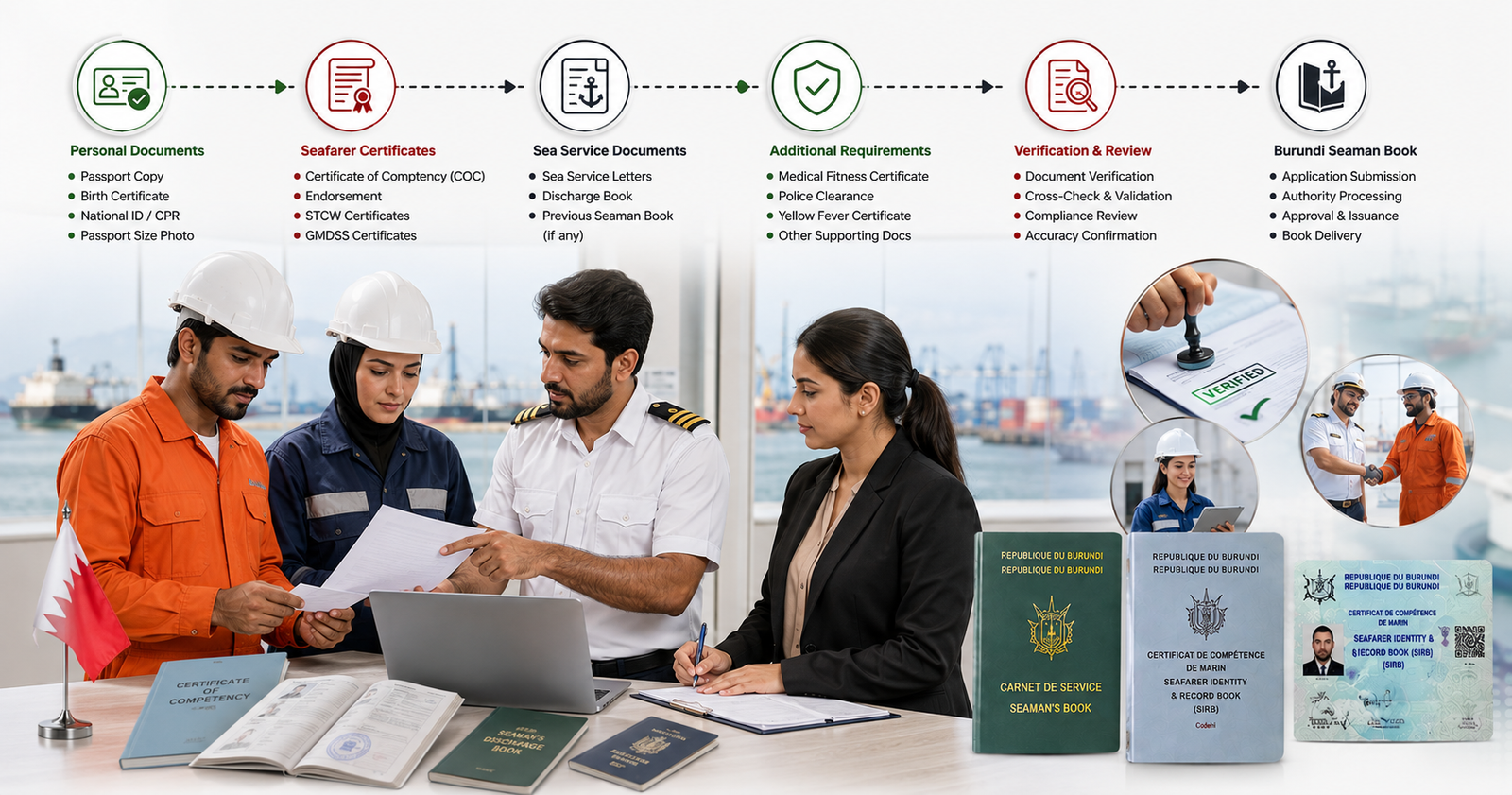
Reproduced from the registry’s Manning Requirement page, retrieved 3 September 2026:
| Requirement | As stated by the registry | What to note |
|---|---|---|
| Application form | Completed in English, typed or legibly printed. Incomplete applications are rejected or delayed | Standard |
| Seaman’s book or passport | Copy of the pages carrying the applicant’s general information. “In the absence of a seaman’s book, a copy of a personal identity documents may be presented” | This is the load-bearing line. A registry that will issue a seafarer record document to someone holding no prior seafarer document is not verifying sea service |
| Certificate of Competency | Copy of the CoC “issued by the Maritime Administration. It must be issued by a country appearing on the White List and approved by TZIRS” | The registry requires your CoC to come from a White List country while claiming, on the same page, to be on that list itself. TZIRS is the Zanzibar register, a different jurisdiction |
| Medical fitness certificate | Examination by a “duly certified practitioner” within 12 months of application | No approved-panel requirement is specified, which is weaker than most flag administrations |
| Passport photographs | Four, facial front view, taken within one year, 1.75 × 1.75 cm, name on reverse | Standard |
Compare that with what a recognised flag administration will require of a genuine first-time applicant: a valid passport with adequate remaining validity, completed STCW basic safety training from an approved centre, a Certificate of Competency or Proficiency appropriate to the rank, a medical fitness certificate from an approved panel practitioner, verifiable sea service or a confirmed employment or cadet contract, and in most cases police or offence clearance, properly attested. The gap between the two lists is the whole story.
Can you get a seaman book without a Certificate of Proficiency?
With a recognised registry, generally no — the CoP or CoC is what the seaman book records. Entry-level ratings usually need STCW basic safety training plus a confirmed contract or cadetship. If a service offers you a seaman book with no training certificate and no sea service, what you are being sold is a booklet, and the qualification gap will surface at the first competent inspection.
How do you apply for a Burundi seaman book online?
The registry operates an online application page and a seaman book verification form that checks an SIRB number against a date of birth. We would not recommend submitting personal documents through it until you have satisfied yourself on the questions in this page, because a completed application means your passport data sits with an entity whose authorisation we could not verify.
Two practical cautions, independent of the recognition question.
Document security. An application requires you to send passport pages, a medical certificate and your Certificate of Competency to a third party. Where you cannot establish who that party is or which jurisdiction’s data protection law binds them, you are accepting a real and separate risk. Send documents to registries and to agents you can identify.
Site integrity. As at 3 September 2026 the registry’s website presented a TLS certificate that failed hostname validation for www.burundiregistry.com. That is a configuration fault rather than proof of anything, but it means data submitted through the site may not be transmitted securely, and it is an unusual state for a national maritime administration’s portal.
There is a broader pattern worth naming, because it is what generates the searches that bring people to this page. A service that promises a seaman book with minimal requirements, no verifiable training certificate, a short timeline and an unpublished fee is describing a document that exists rather than a document that works.

Who needs a seaman book, and which one should you get instead?
Anyone signing on to a merchant vessel, an offshore support vessel, a rig, a yacht above the recreational threshold or an offshore installation as marine crew needs a seafarer identity and service record document. Which registry issues it should be decided by where you will work and who will inspect it, not by which is cheapest.
You need one if you are:
- Deck or engine crew joining a merchant vessel — master, chief officer, second and third officer, chief engineer, second engineer, engineer officer, able seaman, ordinary seaman, motorman, bosun, fitter, oiler, wiper
- Catering and hotel crew on a commercial vessel — cook, steward, messman
- Marine crew on offshore support vessels, anchor handlers, platform supply vessels, crew boats, dive support and survey vessels
- Offshore and oil and gas personnel mobilising by vessel to an installation, where the contractor or the flag requires marine documentation
- Yacht crew on commercially registered vessels
- A cadet on a recognised sea-service programme
Which registry, in practice. The right answer depends on your nationality, your certificates and your trade. Two rules cover most cases.
First, if your own state issues a seafarer document and you are eligible for it, take it. A document from your state of nationality is the strongest thing you can hold, and under the ILO Seafarers’ Identity Documents Convention (Revised), 2003 (No. 185), the duty to issue attaches to nationals. Per ILO C185, Article 2(1), a party shall “issue to each of its nationals who is a seafarer” a conforming document (ILO NORMLEX, retrieved 3 September 2026). Article 2(3) gives a party a discretionary power to issue to seafarers “who have been granted the status of permanent resident”. The convention confers no power to issue to a seafarer who is neither a national nor a permanent resident — which is the structural reason a convention-compliant SID cannot be bought from a state you have no connection to.
Second, where you are sailing on a foreign flag and need that flag’s document, choose on the flag’s standing, and check the same four registers we checked above before you commit. We assist with applications to flag-state registries including Panama, Palau, the Bahamas and India, for seafarers who meet each registry’s own eligibility requirements — see seaman book services.
We will tell you upfront if your case is unlikely to succeed with a given registry, because a refused application costs you the fee and the time and leaves you where you started.
How does Atomiq Consulting (Maritime Visas) handle Burundi seaman book requests?
We do not market, recommend or promote the Burundi seaman book. We will prepare and submit a Burundi application only on the written instruction of a shipowner, operator or manning agent who has recorded in writing that the recognition position set out on this page has been explained to them and accepted. We do not accept Burundi instructions from individual seafarers.
What we do, and what we do not do.
| Step | Atomiq Consulting (Maritime Visas) | The registry |
|---|---|---|
| Explaining the recognition position before any money is spent | We do this in writing, and we require it to be acknowledged | — |
| Advising whether an alternative registry better fits the case | We do this, and in most cases we recommend one | — |
| Compiling and checking the document set | We do this against the registry’s published requirement list | — |
| Lodging the application | We submit on written instruction only | Receives it |
| Issuing or refusing the document | — | Decides |
| Guaranteeing that any port state, flag state or contractor will accept the result | We do not, and no agent honestly can | — |
Where a principal instructs us to proceed, our scope is the preparation and submission. We do not represent that the resulting document will be accepted by any authority, operator or contractor, and we say so in the engagement.
In most cases the conversation ends differently. A crewing manager who came to us for a Burundi document leaves with a Panama or Bahamas route and a Saudi crew visa plan that will actually clear the gate. That is the outcome we are set up to deliver.
What to verify before you apply to any seafarer registry
Four checks, all free, all public, and all doable in under ten minutes. Run them on any registry, including the ones we recommend.
- Is the state an IMO Member State? Check the membership list at imo.org. A registry issuing documents for a state that is not an IMO member is operating outside the framework that port states use.
- Is the state on the IMO STCW confirmed-compliance list? The current circular is MSC.1/Circ.1163/Rev.12, dated 9 July 2019. If the registry claims White List status, find the state in that annex yourself. Claims are not evidence.
- Has the state ratified ILO C185 or C108, and the MLC, 2006? Search ILO NORMLEX by convention. This tells you whether a seafarer identity document from that state has a treaty basis.
- Where does the flag sit on the Paris MoU and Tokyo MoU performance lists? This measures how the flag’s ships actually perform under inspection, which is a fair proxy for how seriously the administration is run.
Then two checks on the entity rather than the state: does the registry publish a fee, and does it publish an address in the state whose flag it claims to administer? A national maritime administration reachable only through a foreign correspondence address and an unpublished price list is telling you something.
Frequently asked questions
How much does a Burundi seaman book cost?
The registry does not publish a fee; its online registration page states that fees are provided on request. Any figure quoted to you is an intermediary’s price. We would treat an unusually low quotation as a reason to ask more questions, not fewer.
Can I get a seaman’s book online without any sea experience?
With a recognised flag administration, generally no. A seaman book records identity and sea service, so a first-time applicant is normally expected to hold STCW basic safety training from an approved centre plus a confirmed contract or cadetship. A service that will issue you a seafarer record document while accepting only a personal identity document is not verifying sea service.
Can I get a seaman’s book without a Certificate of Proficiency?
For an entry-level rating, STCW basic safety training and a confirmed employment or cadet contract are usually the route, and the CoP or CoC follows. For any certificated rank, the CoC is the thing the seaman book records, so it comes first. We will tell you which applies to your rank and nationality before you spend anything.
Which seaman book should a seafarer get for offshore and oil and gas work in the Gulf?
Decide it from your nationality and from the contractor’s approved-document list, in that order. If your own state issues a seafarer document and you are eligible, take that first. Where a foreign flag document is needed, check the flag against the IMO membership list, the STCW confirmed-compliance circular, the ILO ratification registers and the Paris MoU performance list before you apply. We assist with Panama, Palau, Bahamas and India applications for seafarers who meet each registry’s requirements.
Does Atomiq Consulting (Maritime Visas ) issue seaman books?
No. We are a service provider, not an issuing authority. Seafarer identity documents are issued by flag-state registries and national maritime administrations. We prepare applications, submit them, and follow up until the registry issues a decision.
I have already paid for a Burundi seaman book. What should I do?
Do not present it as your primary seafarer document without first asking the party who will inspect it — your manning agent, the vessel’s operator, or the offshore contractor’s compliance team — whether they accept it. Ask in writing and keep the answer. Then apply for a document from your own state of nationality if you are eligible, or from a recognised flag registry appropriate to your trade. Send us your certificates and rank and we will tell you what your realistic route is.
What does Atomiq Consulting do?
Atomiq prepares, verifies, and submits seafarer documents. It is designed for qualified seafarers who need help making sure their applications are complete, accurate, and ready for submission.
Can Atomiq Consulting check if my document is acceptable?
Yes. Atomiq can verify your documents against the relevant requirements and identify issues that may need to be corrected before submission. A document that looks complete is not necessarily acceptable, so verification helps reduce avoidable errors and delays.
Get a straight answer on your case
Tell us your nationality, your rank, your certificates and where you are joining. We will tell you which seafarer document route is realistic for you, what it will cost, and how long it should take — and if we think you should not proceed, we will say so.
Maritime Visas — the maritime visa and crew mobility brand of Atomiq Group, managed in the Kingdom of Bahrain by Atomiq Consulting WLL.
Shop No. 11, BLDG No. 1022, Road 1267, Block 106, Damistan, Ash Shamaliyah, Kingdom of Bahrain Telephone: +973 3505 7701 · Email: prashant@atomiqgroup.com
Request a seafarer document assessment · Seaman book services · KSA crew and maritime visa services